
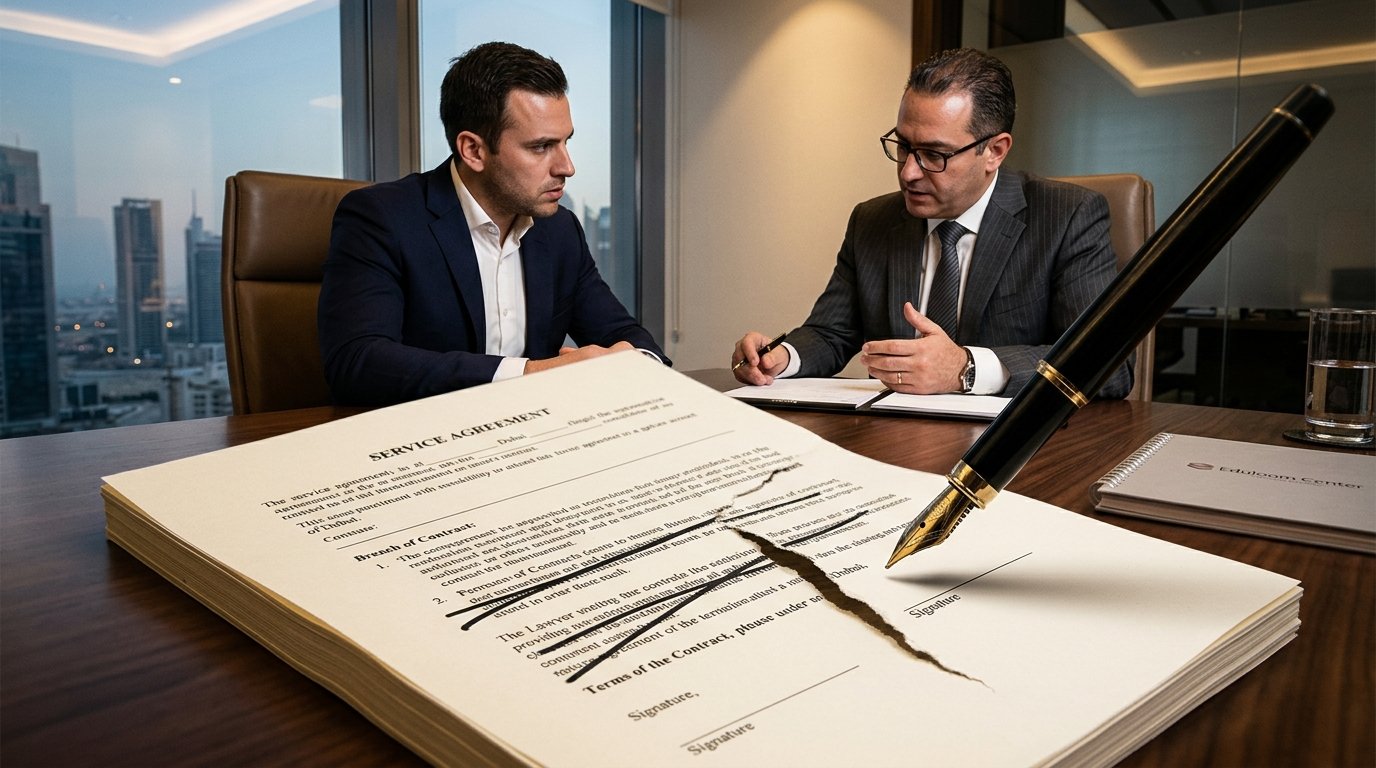
In the fast-paced commercial environment of Dubai, contracts are the foundation of every business relationship. From multinational supply chain agreements and joint venture partnerships to construction contracts and commercial leases, a well-drafted contract provides certainty and allocates risk. But what happens when that certainty shatters? When a supplier fails to deliver, a partner withdraws funding, or a contractor abandons a project, the financial and operational impact on your business can be catastrophic.
Under UAE law, a contract is binding, and a failure to perform contractual obligations is treated as a serious legal matter. However, proving a breach has occurred, quantifying the exact financial damages, and navigating the UAE court or arbitration systems to secure compensation is a highly complex process. It requires immediate, strategic intervention from specialized legal professionals.
This comprehensive guide explains the legal principles governing contracts in the UAE, the remedies available when an agreement is broken, and why engaging expert Breach of Contract Services in Dubai is critical to your financial recovery.
The Legal Framework: Contracts Under UAE Civil Law
The foundation of contract law in mainland Dubai is the UAE Civil Transactions Law (Federal Law No. 5 of 1985, commonly known as the Civil Code). Understanding a few key principles of this code is essential for any business operating in the UAE.
“The Contract is the Law of the Parties”
This fundamental principle (Pacta Sunt Servanda) means that UAE courts respect the freedom of contract. As long as the terms do not violate UAE public policy or mandatory laws, the courts will strictly enforce what the parties agreed to in writing. A party cannot simply walk away from a bad bargain.
The Duty of Good Faith
Article 246 of the Civil Code mandates that contracts must be performed in accordance with their contents and in a manner consistent with the requirements of “good faith.” This means parties must act honestly and fairly in executing the agreement. If a party deliberately frustrates the purpose of the contract or acts maliciously to avoid their obligations, a court may find them liable for a breach of good faith.
Types of Contract Breaches
Not all breaches are treated equally under the law. Legal services are often required to determine the exact nature of the breach, as this dictates the available legal remedies.
- Material Breach (Fundamental Breach): A failure of performance so severe that it defeats the entire purpose of the contract. For example, a supplier delivers entirely defective machinery that cannot be used. A material breach usually gives the innocent party the right to terminate the contract and sue for damages.
- Minor Breach (Partial Breach): The core of the contract was fulfilled, but a lesser obligation was violated. For example, a contractor finishes a building but uses a different brand of paint than specified. The innocent party can seek compensation for the difference in value, but generally cannot terminate the whole contract.
- Anticipatory Breach: When a party clearly indicates—either through words or actions—that they will not fulfill their obligations before the deadline arrives. The innocent party does not have to wait for the deadline to pass to take legal action.
Legal Remedies: What Can You Claim in Dubai?
When a breach occurs, the primary goal of the UAE legal system is to put the innocent party back in the position they would have been in if the contract had been properly performed. Through professional Breach of Contract Services, you can pursue several distinct legal remedies.
1. Specific Performance
Under UAE law, the primary remedy is specific performance—meaning the court will order the breaching party to fulfill their exact contractual obligations, if it is still possible and reasonable to do so. For example, a court might order a developer to hand over the title deed to a property as agreed in the sale contract.
2. Financial Compensation (Damages)
If specific performance is impossible, impractical, or no longer desired by the innocent party, the court will award financial compensation. To win a claim for damages in the UAE, your legal team must prove three distinct elements:
- Fault (The Breach): Clear evidence that the opposing party failed to meet a specific contractual obligation.
- Damage (The Loss): Quantifiable financial loss suffered by your business.
- Causation: A direct, unbroken link proving that the opposing party’s fault directly caused your financial loss.
Note on Lost Profits: Unlike some common law jurisdictions, claiming compensation for “anticipated lost profits” (loss of opportunity) in the UAE is very difficult. UAE courts generally only award damages for actual, certain, and direct financial losses already incurred, not speculative future earnings.
3. Liquidated Damages
Many commercial contracts include a liquidated damages clause—a pre-agreed amount or formula to be paid if a specific breach occurs (commonly seen as delay penalties in construction contracts). UAE courts will generally enforce these clauses. However, under Article 390 of the Civil Code, a judge has the discretion to adjust the liquidated damages amount (up or down) to reflect the actual harm suffered by the innocent party, regardless of what the contract says.
4. Contract Termination
If the breach is material, you may wish to simply terminate the contract and recover any monies paid. However, under UAE law, unless the contract contains a specific, strongly worded automatic termination clause, you generally cannot unilaterally terminate a contract. You must obtain a court order confirming the termination. An experienced lawyer ensures that the termination procedure is legally valid to prevent the opposing party from counter-suing you for wrongful termination.
The Crucial Step: The Formal Legal Notice
Before rushing to court, UAE law generally requires the innocent party to formally notify the breaching party. This is a critical procedural step. A Legal Notice (often sent via the Notary Public) officially puts the party on notice that they are in breach, gives them a specific timeframe to rectify the breach, and warns of impending legal action if they fail to comply.
A strongly drafted Legal Notice on a law firm’s letterhead often serves as a powerful negotiation tool, prompting the breaching party to settle the matter amicably to avoid court costs and reputational damage. If the case does go to court, the Legal Notice serves as vital evidence that you acted reasonably and gave the party a chance to cure the defect.
Force Majeure: The Unforeseen Circumstances Defense
In recent years, the defense of “Force Majeure” (an unforeseeable and unavoidable event, like a natural disaster or pandemic) has become a major focus in contract disputes. If a party successfully proves Force Majeure, the UAE courts may temporarily suspend contractual obligations or even cancel the contract without liability.
However, an economic downturn, a drop in market prices, or a lack of personal funds does not qualify as Force Majeure. Furthermore, the UAE recognizes the concept of “Exceptional Circumstances” (Article 249), where an unforeseen event makes performance exceptionally oppressive (but not impossible). In such cases, a judge can adjust the contract terms to distribute the loss fairly between the parties.
Why Specialized Breach of Contract Services Are Essential
When a commercial agreement collapses, attempting to resolve it through angry emails or DIY legal action is a fast track to financial loss. Engaging a specialized law firm provides critical strategic advantages:
- Contract Analysis: A lawyer will analyze the contract to determine the exact scope of the breach, the validity of exclusion clauses, and the correct dispute resolution forum (Dubai Courts, DIFC Courts, or Arbitration).
- Evidence Gathering: Proving causation and quantifying damages requires meticulous preparation of documents, emails, financial records, and often expert witness reports.
- Procedural Compliance: The UAE courts operate on strict procedural rules regarding legal translation, notarization, and statutory limitation periods. Mistakes here can result in a valid claim being dismissed.
- Strategic Leverage: Sometimes, the goal is not to endure a three-year court battle, but to use the threat of litigation to negotiate a favorable commercial settlement and salvage the business relationship.
Conclusion: Act Quickly to Protect Your Position
A breach of contract is an immediate threat to your business’s financial stability and operational continuity. The longer you wait to address it, the harder it becomes to secure evidence, the higher the financial damage mounts, and the greater the risk that statutory time limits will expire.
By engaging expert Breach of Contract Services in Dubai immediately after a breach occurs, you ensure that your legal position is protected, your financial losses are aggressively pursued, and your commercial interests remain the absolute priority.